


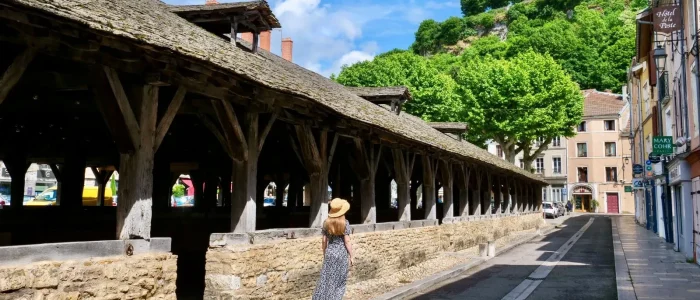

Parmilieu
Welcome to Parmilieu, a village located north of the Balcons du Dauphiné.
If the history of this town is closely linked to the exploitation of stone, perhaps, less well known, it is also a village where many writers have stayed.
It is important to emphasize first of all that the presence of Gallo-Roman settlement sites has been attested there as well as archaeological traces dating from the Bronze Age. These signs clearly show the permanence of human societies in Parmilieu since prehistory.
1. The stone
Parmilieu is located on the northern tip of the limestone plateau of Isle-Crémieu. Over its entire extent, this village offers a great plurality of landscapes: from the wooded areas of Serverin in the north to the farms in the south-east.
It is from this limestone deposit that Parmilieu stone called “stone” or “choin” of Villebois is extracted. Recognized for its resistance and ease of polishing, its intrinsic qualities naturally make it a material of choice for builders, including today and internationally! We find it within prestigious buildings or infrastructures such as the entrance to the Croix-Rousse tunnel, the quays of Lyon, the hall of the Wall Street stock exchange in New York and the Stade de France!
Until 1830, the main activity of Parmilieu remained agriculture, as is the case for the majority of villages in France.
However, it is from this pivotal year that we will identify the first requests to open careers. A new economic era then opened for Parmilieu with the start of the exploitation of cut stone quarries: Allardon, Chavant, Dechanaux, Gerbod, Grivet, Guillet.
It was at this same time that the so-called quarry houses appeared; These are simple stone houses built around old farms. It is not uncommon, in fact, that within the same family, men occupy an activity linked to careers, while women devote themselves to agricultural activities. Some typical houses in Parmilieu perfectly illustrate this dual activity.
In the 30st century, Parmilieu had up to XNUMX limestone quarries playing an important role in the economic and demographic development of the village. At the end of the century, we noted the decline of this activity, in particular because of the arrival of concrete on the market.
2. Heritage
– The Saint-Pierre de Parmilieu church.
Its construction is estimated to have begun at the end of the 1666th century. The church is named after Saint Peter and Saint Paul. At the beginning of the XNUMXth century, the church was very poor and had very few objects of worship. This situation will evolve positively over the century, notably thanks to the resumption of the side chapels made possible by the parish priest in XNUMX, Pierre Mugnier de Boulieu.
In 1801, the Concordat (treaty between the French Republic of Bonaparte and the Holy See of Pius VII organizing relations between the State and religions) considerably reduced the number of parishes. Parmilieu is therefore attached to the parish of Amblagnieu. The church of Parmilieu suffers from this abandonment since the population must now go to Amblagnieu or La Balme for certain sacraments, notably baptisms.
The municipality will therefore ask in 1829 that its church be established as a branch so that the State can assume the financial burden. This request would not succeed until 1846! During these transitional years, it was the population who, from 1831, financed the assignment of a priest to Parmilieu.
The church nevertheless remains an undersized building: according to a visit report from the bishop in 1856, a third of the population does not have access to services due to lack of places. However, no expansion will be carried out due to lack of financial resources.
In 1869, the widow of Joseph Allardon honored a promise made to her husband and made a donation which allowed the purchase of a monumental clock.
In 1871, the condition of the church was finally considered satisfactory! It then has the appearance we know today: 24 m long and 5 m wide, in a Latin cross layout with two chapels. It has a high altar in varnished and gilded wood as well as a large quantity of priestly ornaments.
However, once again, in 1901 his condition was considered alarming and dangerous. After formal notice from the municipality in 1909, security work was carried out. However, it was not until the last major restoration in the 1970s and 80s that the church reached its current state.
In 1976, a new bell called “Clotilde” was installed. She even inspired the poet G. Clopeau:
“Bronze soul of the bell tower
Who calls us to prayer
In the welcoming stone nave,
To the sounds of your close neighbors
Porcieu, Charette, Montalieu,
Mix the voice of Parmilieu
Over valleys and hills. »
– The Serverin estate surrounded by the eponymous forest: after having been a railway sleeper factory and a silkworm farm with the Tabard then Thomann families, the estate was transformed into a reception center for holiday camps between 1895 and 1913 In 1920, it became the property of the city of Lyon, which used it to educate children in specialized classes.
Vernacular heritage:
The agricultural landscape of the region is marked by:
– Chapits: these pastoral shelters, made up of three vertical stones topped with a fourth roof, allowed shepherds and agricultural workers to protect themselves from bad weather.
– Bigues: used as vine stakes, these solid structures carved from local stone are witnesses to a bygone period of wine culture.
– The bocage network: made up of meadows enclosed by hedges and dry stone walls, this landscape is typical of Parmilieu. It is completed by plant stones also called palis. These large stones planted in the ground were used to demarcate properties (1/3 of the stone is hidden in the ground).
– The marinieres or confusions: enormous heaps of stone which are the lowest quality stones which are not used by industries and constitute the waste of the quarry.
– The Pressieu silkworm farm: this old farm bears witness to the history of local sericulture (silkworm breeding) and offers an overview of this very widespread activity in the 19th century. Often carried out by women, it allowed a significant additional salary for the families of “Pierreux”.
In addition to the silkworm farm, many granaries were reserved for the breeding of silkworms, the cocoons of which were then sent to the silk weavers in Lyon.
– The village also has 3 ordinary ovens, 3 wash houses including the Senin wash house carved out of the rock, as well as a well and mission crosses.
2. Literature
Parmilieu can rightly be proud of the fact that renowned writers have stayed there: Paul Claudel, Alphonse Lamartine, Prosper Mérimée...
Among them, the illustrious Louis Aragon (1897-1982) whose poem Le concrit des cent villages evokes Parmilieu. This work, written clandestinely in 1943, in the midst of the German Occupation, first appeared in the resistance magazine Messages, before being included in the collection La Diane française. Through this poem, Aragon addresses all the conscripts who cross the countryside and villages of France to join the Resistance, among whom is Parmilieu!
[I take with me as luggage
A hundred villages without a place otherwise
The ancient antiphon of their names
The fragrant flower of language
A romance my way
Love of my country memory
A necklace without end or clasp
The miracle of a song
A little brown and blond earth
On the black hole of my sorrow
I take the chorus with me
Of a hundred names said by everyone
Farewell, Forléans, Marimbault,
Vollore-Ville Volnérange
Avize Avoine Vallerange
Ainval – Septoutre Mongibaud
Fains-La-Folie Aumur Andance
Guillaume – Peyrouse Escarmin
Dancevoir Parmilieu Parmain
Linthes – Crying Caress Abundance]
We also note the writer Henri Béraud, a child of Parmilieu, some of whose novel characters are closely linked to Parmilieu's quarry past. Frédéric Dard, in his novels C'est mort et ça ne sais pas and Fleur de nave vinaigrette, also evokes the careers of Parmilieu and Montalieu-Vercieu.
4. Hiking:
"In the land of stone, tour of Parmilieu by the Bigues trail" (6,2km – 1h45 – 80m d+): this hike where stone is omnipresent will allow you to learn more and enter this quarry basin.
(Hiking sheet on sale for €1 in the offices of the Balcons du Dauphiné Tourist Office).
Themes
Visit
Individual visit services
- Unguided individual tours permanently
Opening
All year round, every day.
Prices
Free access.
Linked offers
On site:


